
The B2B customer journey spans several phases from procurement through renewal, and different internal teams own each one. Marketing, Sales, Product, Accounts, and Customer Support — among others — all play an integral role in the greater customer experience (CX) strategy.
These teams rarely get to see what’s happening outside of their silos, and they each optimize for their own metrics. As a result:
- Customers experience disconnected touchpoints: To them, it feels like they’re constantly starting over and “explaining their story” to new people.
- Value messaging changes across the journey: Ad campaigns focus on Outcome A, the proposal focuses on Outcome B, and onboarding is set up to help them achieve Outcome C.
- Customers feel bait-and-switched: Marketing and Sales may make promises early on that Product and Accounts lack the resources to deliver on.
Customers don’t see or care about the nuances between your teams. They see just one company — and they expect a cohesive experience that reflects that.
>>Team silos undermine the CX strategy
Silos are normal in B2B orgs. And in many circumstances, it makes sense to let teams focus on their own slice of the greater customer journey. But without systems in place to enable visibility across the ecosystem, it’s hard to deliver a cohesive customer journey. It’s also hard to figure out what’s going wrong — and right — with the current experience.
Different teams have different perspectives and anecdotes about why deals are lost and why customers churn. This internal disagreement makes it unclear where the true friction lies in the B2B customer journey, and which change initiatives to prioritize.
Cross-functional B2B teams also tend to lack visibility into the great things happening outside of their bubbles. Certain customer-centric moments could be true differentiators for your brand, but if Marketing and Sales don’t know about them, they remain hidden to prospective customers.
Your teams need a shared understanding of the customer, the company’s strategic direction for CX, and your org’s right to win. This doesn’t come naturally; it has to be built.
<!-- blog-case-study-highlight-01 -->
>>How B2B customer journey mapping helps
B2B customer journey mapping gives your organization a single source of truth about the end-to-end customer experience. Shared journey maps align teams — Sales, Marketing, Customer Success, and more — on both the friction points to resolve and the best parts of an experience to lean into.
Learn how to unify siloed teams around a strong B2B customer journey:
>>1. Map the journey with customers
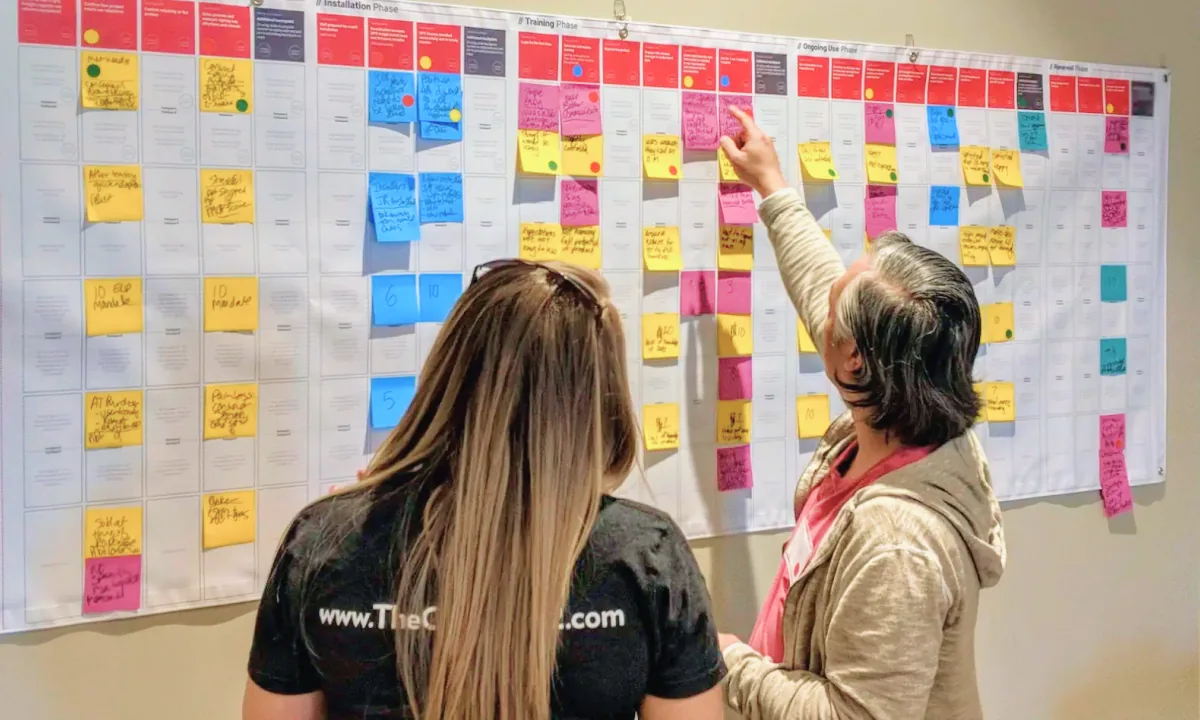
The first step is understanding the journey through the lens of customers. B2B customer journey maps provide a full snapshot from the B2B buying process through renewal (or churn).
B2B journey mapping firms often conduct customer research first, and then bring those insights to the journey mapping session. Instead, we recommend involving customers as participants in the B2B journey mapping workshop to research and map at the same time — which strengthens the outcomes of both in the process.
You’ll learn about friction points and defining moments (key emotional touchpoints that define an experience) straight from the source: your customers. This positions you to design the ideal CX with structured, solid evidence, instead of anecdotes or internal assumptions.
<!-- blog-case-study-highlight-02 -->
>>2. Co-create the ideal B2B customer journey
With direct voice-of-customer research and a snapshot of the current journey in hand, the next step is designing a more customer-driven CX strategy. This doesn’t have to be months down the road; it can happen in the same week (or day) that you created the current-state journey map.
What matters most is who you involve in the customer experience design process. To build a customer-driven CX strategy that teams can align on, involve the right people:
- Current customers (those who are happy, and less than happy)
- Prospects who chose competitors instead
- Former customers who churned or switched to competitors
- Stakeholders from key teams involved across the organization
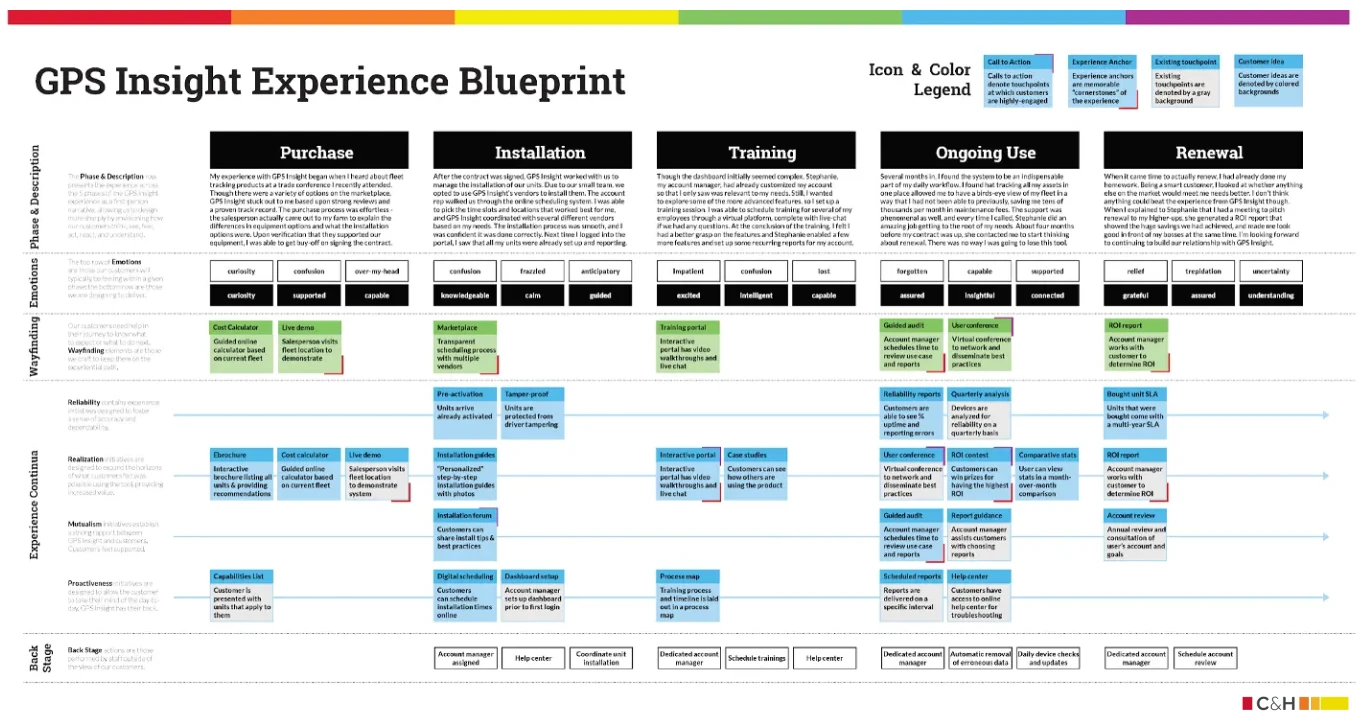
View an example of a customer-centric experience strategy for a B2B company, delivered by Cast & Hue:
>>3. Align on next steps
The new CX strategy (which we call an experience blueprint) becomes your north star. It aligns cross-functional teams around issues to prioritize, answering questions like, “Which changes should we roll out first?” and “Where does it make the most sense to allocate resources for this?” (We’re here to help you answer these kinds of questions about CX strategy implementation.)
You’ll also learn which moments of the journey are the best, according to customers. These are the touchpoints to solidify as part of your strategy, carry across locations, and amplify in your marketing and sales materials.
>>Our approach to B2B customer journey mapping
At Cast & Hue, we facilitate customer journey mapping workshops for B2B companies that involve the right people: your customers and cross-functional teams.
Our approach is grounded in a human-centered philosophy and the belief that diverse perspectives are integral to successful CX strategies. We’ve found that building the plan alongside those who will implement it — your teams — helps start change initiatives off on the right foot and sets our clients up for the best long-term outcomes.
Align your org around a human-centered CX strategy
Reach out to talk about B2B customer journey mapping and how to align your teams around a shared understanding of the customer.
REACH OUT TO US →