
Not all journey maps are made equal
When done well, journey maps outline insights to improve many arms of an organization. When not done well, journey maps gather dust in a shared drive.
Over the years, as customer and patient experience consultants at Cast & Hue, we’ve come across old journey maps that were surface-level, inaccurate, or otherwise not useful. Whether a map becomes an asset or gets chalked up as an expense comes down to how it was created.
Below are 5 of the most common customer journey mapping mistakes that we’ve seen crop up as patterns. Avoid these to create a journey map that makes a real difference.
>>Journey mapping pitfalls to avoid
1. Not including customers or patients
This is the most common mistake we see in journey mapping. Teams often map the experience based on how internal stakeholders in leadership, sales, and customer support understand it.
This inevitably leaves out the people who know the journey best — customers and patients — letting assumptions drive the process. Because no matter how hard stakeholders try, studies have shown they can’t remove their biases enough to truly understand the customer's point of view.
At the same time, baseline customer research is not an effective substitute for active customer participation. Here’s why:
- Surveys can tell you that something isn’t working, but not why.
- Focus groups are often biased by groupthink.
- Customer reviews can be a helpful starting place, but they lack crucial context for decision-making.
Deep qualitative insights, which are integral to effective journey maps, are only uncovered from speaking with real customers or end users.

2. Only including satisfied customers or patients
Satisfied customers and patients can tell you what’s working in your journey and why. But it’s just as critical to know where the journey isn’t meeting expectations.
By only speaking with those who are happy, you risk missing crucial friction points that tell you why people aren’t converting or why some have switched to a competitor.
In customer research, be sure to include:
- Happy customers or patients who stay loyal to your brand
- Lukewarm customers or patients who aren’t as satisfied
- Former customers or patients who left your brand
- People who never converted to customers or patients
Loyal customers are often the most willing to participate in initiatives and the first to raise their hands during the exercise. Partner with external recruiters to reach a diverse mix of participants and experienced journey mapping facilitators who can encourage input from everyone.
3. Journey mapping without frontline staff
Beyond internal stakeholders and consumers, employees are an important group to include in journey mapping — specifically, the staff responsible for delivering key experiences.
Including frontline staff in customer journey mapping can help you:
- Better understand consumers: Employees know the experience from a key angle — the field. They’ve been on the other end of a frustrating or confusing customer journey, making their insights invaluable.
- Drive employee engagement: When people know their ideas are being considered, they feel more involved in the outcomes of strategic initiatives.
- Improve implementation: Active employee involvement also supports implementation. When staff members help come up with new strategies, they believe in them, and are often more willing to make those changes to their workflows.
- Boost both employee and customer experience: The employee experience and customer experience are closely related. Improvements to one will positively impact the other. 85% of companies reported that improved employee engagement led to higher CX scores, improved customer satisfaction, and importantly, higher revenue.
- Start shifting company culture: Providing employees with opportunities to hear the customer or patient’s perspective helps develop an organization-wide mindset of empathy. Here’s why that matters.
4. Underestimating the importance of emotions
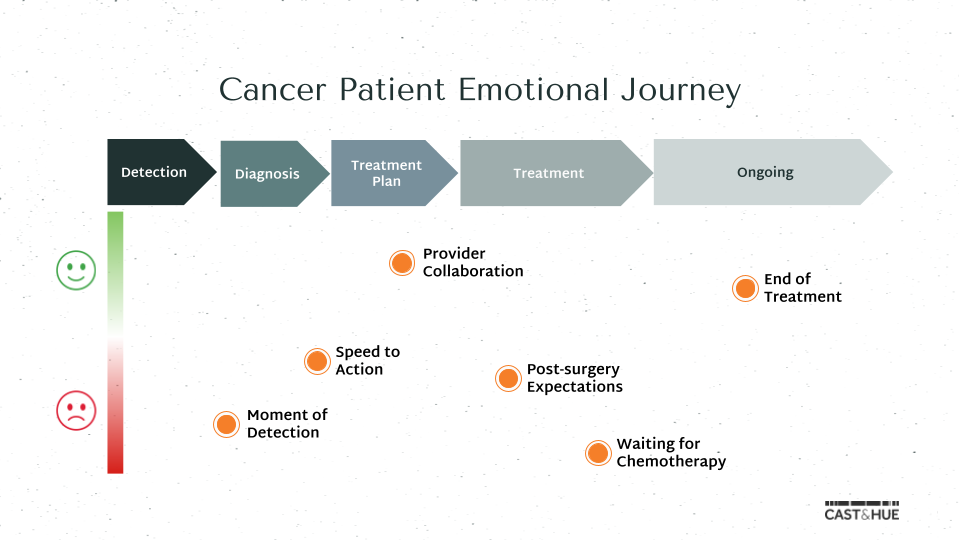
At a baseline, most journey maps consist of touchpoints and actions. Sometimes they include pain points and opportunities. But the emotional journey is often overlooked, even though it's the most critical element.
Emotions are closely linked to how people perceive, remember, and talk about your organization. By analyzing the emotional journey, we can go beyond identifying pain points to finding the defining moments — positive and negative — that leave an imprint on customers and patients.
This helps you prioritize the most crucial moments and redesign them to create a memorable, loyalty-driving experience.
See how emotions change across a customer journey:
5. Setting and forgetting journey maps
Customer journey maps only bring value when they’re up-to-date and actually acted on.
Teams often leave a journey mapping session energized about what they can do next. But they sometimes become overwhelmed with all of the options, or more pressing day-to-day items take precedence. Fast forward a year, and nothing’s been done to improve the journey.
Ensure you’re acting on the crucial insights you uncovered through effective journey mapping. Don’t let them expire in a shared drive. Use them to:
- Redesign your experiences
- Train your staff
- Drive innovation with empathy
Then, measure and track progress (especially for defining moments) and update your maps as business practices and customer expectations evolve. People’s needs are much different in 2025 than they were in 2020. Keep your maps current to account for these shifts.
>>How to create an effective customer journey map
Putting together the do’s and don’ts above, here’s how to create journey maps with insights you can act on:
- Involve the end user: This ensures that your journey maps reflect reality. Include a diverse group of people — including those who aren’t your customers — to cover a variety of needs and motivations.
- Involve employees: Bring in frontline staff as active participants during the mapping process (not just to “add color” after a map is created). Prioritize input from those responsible for delivering the experience, such as customer support representatives, sales teams, front office workers, janitorial staff, or IT.
- Focus on quality of insights: Aim for depth. Ask questions and dig in deeper to responses, even if you don’t know yet whether you’re digging in the “right” direction. Effective journey mapping requires a balance between deliberate facilitation and exploration — sometimes, the facilitator needs to let insights steer.
- Map emotions: Don’t just talk about customer and patient emotions at different touchpoints. Include them within your maps (both negative and positive).
>>Who to involve in customer journey mapping sessions
A number of voices should help shape your maps. Learn why it’s important to involve diverse perspectives in strategic exercises like customer journey mapping.
.webp)



.png)


.png)