
Customer interviews, journey mapping sessions, and design thinking workshops excel at uncovering deep, nuanced insights that pave the way for meaningful CX improvements.
The challenge is knowing what to do with those insights and which improvements to ultimately execute. This is why it’s common for teams to lose momentum after the research has ended and when it’s time to implement changes. They have scattered ideas, but no clear direction yet.
This article is about a design tool that bridges the gap between insight and execution: the experience blueprint.
>>What is an experience blueprint?
An experience blueprint is a document that aligns teams on one overarching vision for the ideal CX or EX. It turns insights and ideas into a clear, cohesive future-state experience. The tool serves as a reference point to guide strategic changes and everyday delivery.
Practically speaking, the blueprint is a graphic artifact that illustrates:
- The experience’s key phases
- Customer and employee actions at each phase
- An overall direction for the intended future-state experience
It helps teams align on the experience strategy, see how individual ideas or touchpoints fit into it, and determine how to deliver it consistently.
Note: The experience blueprint is a critical step before implementing changes, but it’s not the only step. Read our full process for implementing a new experience.
>>How do you use an experience blueprint?
Customer experience blueprints are shared resources. Organizations that see the most success share the blueprint across departments, including leadership, marketing, product development, HR, and customer-facing roles. This supports a team effort towards the shared goal — the ideal CX.
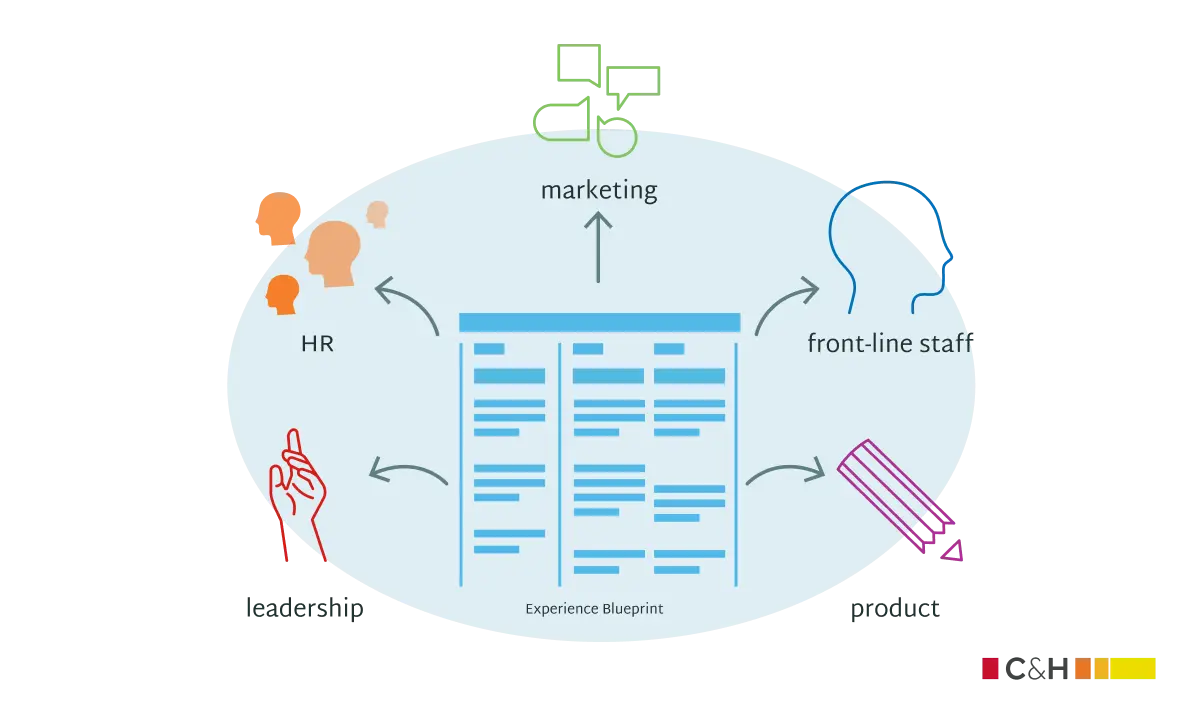
What’s key is encouraging teammates to return to the blueprint to ensure they’re on the right path and to hold themselves accountable. Leaders should model this behavior; referencing the blueprint in team meetings and using it as a north star to guide reflection and decision-making.
Because of this, the blueprint shouldn’t live and die in a digital folder. Distribute physical copies and even paste it on the wall as a visual reminder.
>>Experience blueprints vs. journey maps
We often hear the question, “What’s the difference between an experience blueprint and a journey map? Both resources outline the phases of the customer journey and what happens at each phase.”
The critical difference is that journey maps reflect the current experience, while experience blueprints define the ideal future-state. Journey maps show where you’re starting from. Experience blueprints show what you’re working towards, which helps guide any changes you make.
>>Experience blueprints vs. service blueprints
Experience blueprints may also seem comparable to service blueprints. In a customer service environment, how are these tools different?
Experience blueprints go beyond traditional service blueprints by shaping the holistic human experience. Service blueprints map touchpoints and backstage processes. Experience blueprints zoom out, designing the end-to-end experience across teams, channels, and systems — all anchored in how people want to feel.
>>What do experience blueprints include?
No two experiences are the same. That’s why we don’t use a standard experience blueprint template. The structure should reflect what’s most important to your organization and the people you serve.
That said, employee and customer experience blueprints often include a few core elements:
- Narratives of the future experience or its phases
- Emotions experienced across the journey
- Wayfinding elements that help the customer know what to do next
- Experience elements (what happens at each phase)
- Experience anchors, or the defining moments that exceed expectations and shape brand loyalty
View an example of an experience blueprint created by Cast & Hue. It defines each phase of the Arkansas Children’s Hospital’s cardiology experience, including emotional states, actions taken at each stage, and opportunities for innovation — or ideas for touchpoints that could become defining moments.
.webp)
>>How are Cast & Hue’s experience blueprints unique?
Cast & Hue’s experience blueprints go beyond mapping touchpoints and actions. As seen in the Arkansas Children’s example, our blueprints define the core experience themes that matter most to end users (customers and employees).
These themes, which we call continua, capture what people want from their experience with your organization and what they go on to remember about you. Continua are represented in blueprints at every phase of the experience and can give criteria for future design elements. They turn scattered interactions into a seamless experience and positive association of your brand.
For example:
- Disney’s experience themes might relate to wonder, personalization, belonging, and delight.
- Trader Joe's experience is known for approachability, trust, discovery, and human warmth.
- Nike’s customer experience centers around empowerment, motivation, identity, and performance.
- Apple’s experience continua could be described as simplicity, quality, seamlessness, and consumer privacy.
Notably, only your customers and employees can tell you what’s important to them. Making assumptions about this risks the integrity of your blueprint and the outcomes it drives. This is why it’s critical to involve customers and employees from the beginning of this work, in order to capture their nuanced perspectives and co-create meaningful solutions.
Do your experiences evoke the right feelings?
Experiences shape brand perception, whether or not they’re deliberately designed. By building yours intentionally and considering what matters to the people you serve, you can shape the narrative around your organization.
Cast & Hue’s experience design consultants help organizations differentiate themselves with exceptional customer, patient, and employee experiences. Reach out to explore what this could look like for your organization.


.png)


.png)