
Experience is a system
Employee and customer experiences don’t occur in a vacuum, yet many organizations treat them that way.
Both elements make up one holistic experience system. Friction on either side of the equation affects the other:
- When employees can’t execute on the ideal customer experience, CX suffers.
- When customer needs aren’t met, employees front the burden, eroding EX.
This relationship feeds a vicious cycle. Frustrated employees lead to dissatisfied customers, who in turn make employees’ jobs even harder — further impacting CX delivery.
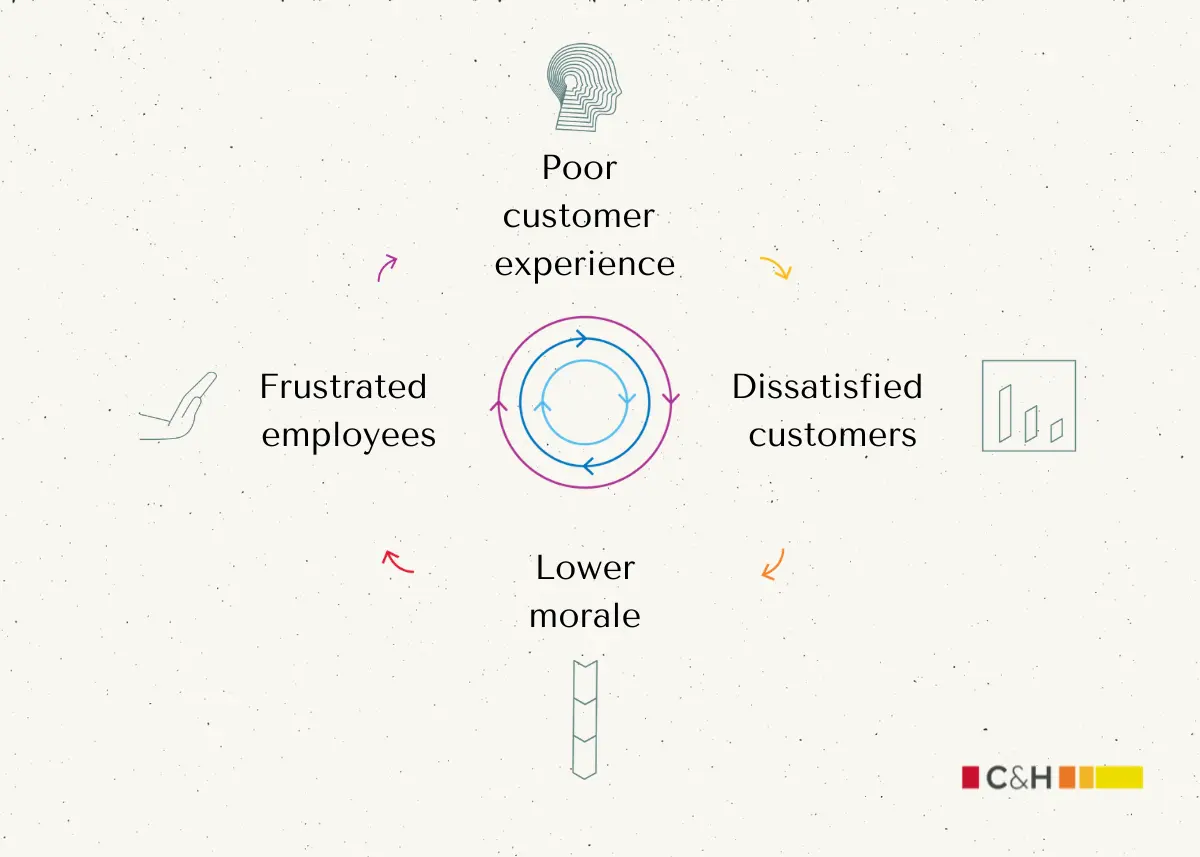
To stop the cycle, recognize that the system is more than the sum of its parts. Learn how each part of the experience impacts the other, and how to enhance both.
>>How employee experience affects customer experience
Employees are at the heart of the customer experience; they’re the people who deliver it. Their experience directly influences how they interact with customers — and, as a result, how customers perceive your organization.
While culture starts with employees, customers feel it, too. A healthy organizational culture creates a workplace where employees are better equipped to handle customer needs, happier at work, and less likely to leave their roles.
Employee agency
Employees need the tools and authority to deliver a strong CX. Without the necessary tools, they can’t adequately serve customer needs. And without enough authority to make minor, on-the-spot decisions, their hands are tied from being able to go “above and beyond” for customers.
For example, a restaurant server might want to surprise guests celebrating their anniversary with a free dessert or glass of champagne. But if they need management’s approval to do so, that bottleneck could prevent them from being able to deliver that personalized touch.
Employee happiness
Customers notice when employees are happy — or dissatisfied — at work. Those emotions bleed into customer touchpoints and affect how they interpret the overall experience.
But employee happiness can’t be created, trained, or forced; it must be authentic. This is why it’s crucial for employees to have a hands-on role in shaping their own experience at an organization. Instead of asking for employees’ feedback after handing down a change, bring them in at the beginning to play an active part in problem-solving or designing new experiences.
Employee retention
Employee retention directly translates into a stronger CX. Tenured employees have a deeper, more nuanced understanding of customers that comes from thousands of hours of on-the-job practice. Their cumulative experience helps them anticipate customer needs earlier in an interaction than new hires or early-career professionals.
Having spent more time at the organization, they’ve also run into the kinds of challenges that come up infrequently, and know the workarounds that aren’t trained in initial onboarding. Their institutional knowledge and confidence makes a tangible difference in the customer experience.
Related: What other elements impact the customer experience? Read about more common culprits behind CX problems.
>>How customer experience affects employee experience
Just as EX impacts CX, the opposite is true. Positive customer interactions energize and motivate teams, while poorly designed experiences create stress and frustration for those delivering them.
Customer happiness
It feels good to help people — and that’s true for employees, too. Delivering a positive experience is inherently rewarding.
Beyond the intrinsic reward, positive customer interactions create a ripple effect. When customers are satisfied, they’re often more patient, respectful, and more likely to express gratitude. Sometimes they leave a kind review or mention a team member by name. That recognition can boost morale and give managers something concrete to celebrate.
CX deliverability
A poorly designed CX sets employees up for failure, as it could be difficult or impossible to effectively deliver. Experiences designed with employee input take into account what’s realistic, so there’s less friction for employees to execute on it.
This is why it’s important to include multiple perspectives in the design process. When the customer experience is designed effectively, everyone wins.
>>How to treat experiences as an integrated system
Customer and employee experience are two parts of the same ecosystem. Designing them together — through cross-departmental collaboration and genuine human insight — ensures both sides work in harmony.
1. Design CX and EX together
CX and EX initiatives shouldn’t be separate “projects.” They’re best addressed in one cohesive initiative.
Why? When improving EX, you might unintentionally change something within CX, and vice versa:
- Streamlining a process for employees could introduce friction for customers.
- A solution you come up with to improve CX might not be possible for employees to deliver.
Designing your organization’s EX and CX strategies in tandem keeps the system balanced. This aligns with a growing trend in the experience design space to incorporate CX and EX (along with other experiences) into a holistic TX (total experience) strategy.
FAQ: Who leads the total experience strategy?
This is a common question for organizations that don't have a Chief Experience Officer with a holistic view of the customer and employee experience. Depending on the organization’s structure, strategy or operations leaders are often best positioned to take the lead. These roles typically have cross-functional visibility and the authority to align departments around shared goals.
2. Collaborate across departments
Different arms of an organization have valuable insights to lend to experience design projects. For example:
- Marketing knows the customer.
- HR understands the employee.
- Leadership represents the business objectives.
Bringing these perspectives together helps ensure the solutions you design are desirable, viable, and feasible — and able to be consistently implemented across your entire org.
3. Integrate the human perspective
You can learn the most about the employee and customer experience straight from the source — employees and customers. By involving them in the design process, you create solutions that are realistic for employees and meaningful for customers.
This approach also gives leaders visibility into how organizational culture is felt on both sides. A positive culture can’t be manufactured from the top down (or as we call it, the inside-out); it comes from an outside-in approach that values employee and customer perspectives.
Related: Learn how a design thinking culture benefits your organization.
>>See it in action: Joint CX and EX projects
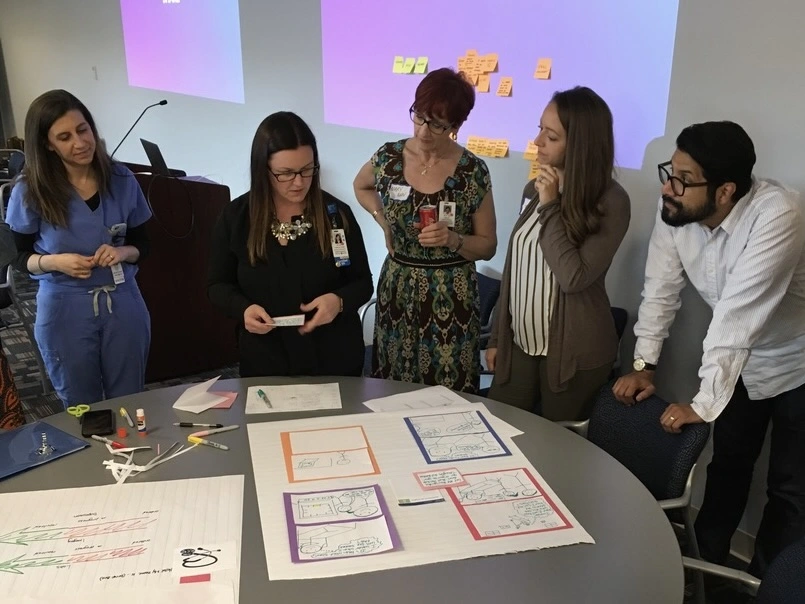
Curious to see what a holistic approach to experience design looks like? Cast & Hue’s experience design consultants helped two clients improve their CX and EX in tandem.
<!-- blog-case-study-highlight-01 -->
<!-- blog-case-study-highlight-02 -->
.webp)
For exceptional results, take an unconventional approach
It’s common for organizations to work on customer and employee experiences in silos. It’s also common to run into issues when employees can’t deliver on the promises of a new experience, or when EX-focused changes inadvertently impact customers.
At Cast & Hue, our consultants redesign customer and employee experiences together so that the end result is one strengthened system that you have full visibility over. In the process, we can even train your team on these skills so they can carry the momentum forward.


.png)


.png)