Understanding each approach
Design thinking, agile, and lean are 3 distinct approaches used for designing a new product or experience. There’s an overlap between them, and some of the differences come down to nuance. This can make it confusing to know which is “right” for what you’re working on.
Let’s start with an overview of each model.
What is agile?
Agile is an approach to software development and project management that delivers solutions through quick, iterative cycles. Teams work in sprints, gather continuous feedback, and adjust based on what they learn.
The philosophy is based on the Agile Manifesto created in 2001. While there are many agile frameworks, such as Scrum and Kanban, each one is rooted in delivering value in small, manageable increments.
What is lean?
Lean centers on identifying and eliminating waste — any activity that doesn't benefit the end user. It originated in manufacturing and expanded into other industries (particularly, SaaS).
Lean Enterprise Institute defines the philosophy as “a way of thinking about creating needed value with fewer resources and less waste” through continuous process improvement.
What is design thinking?
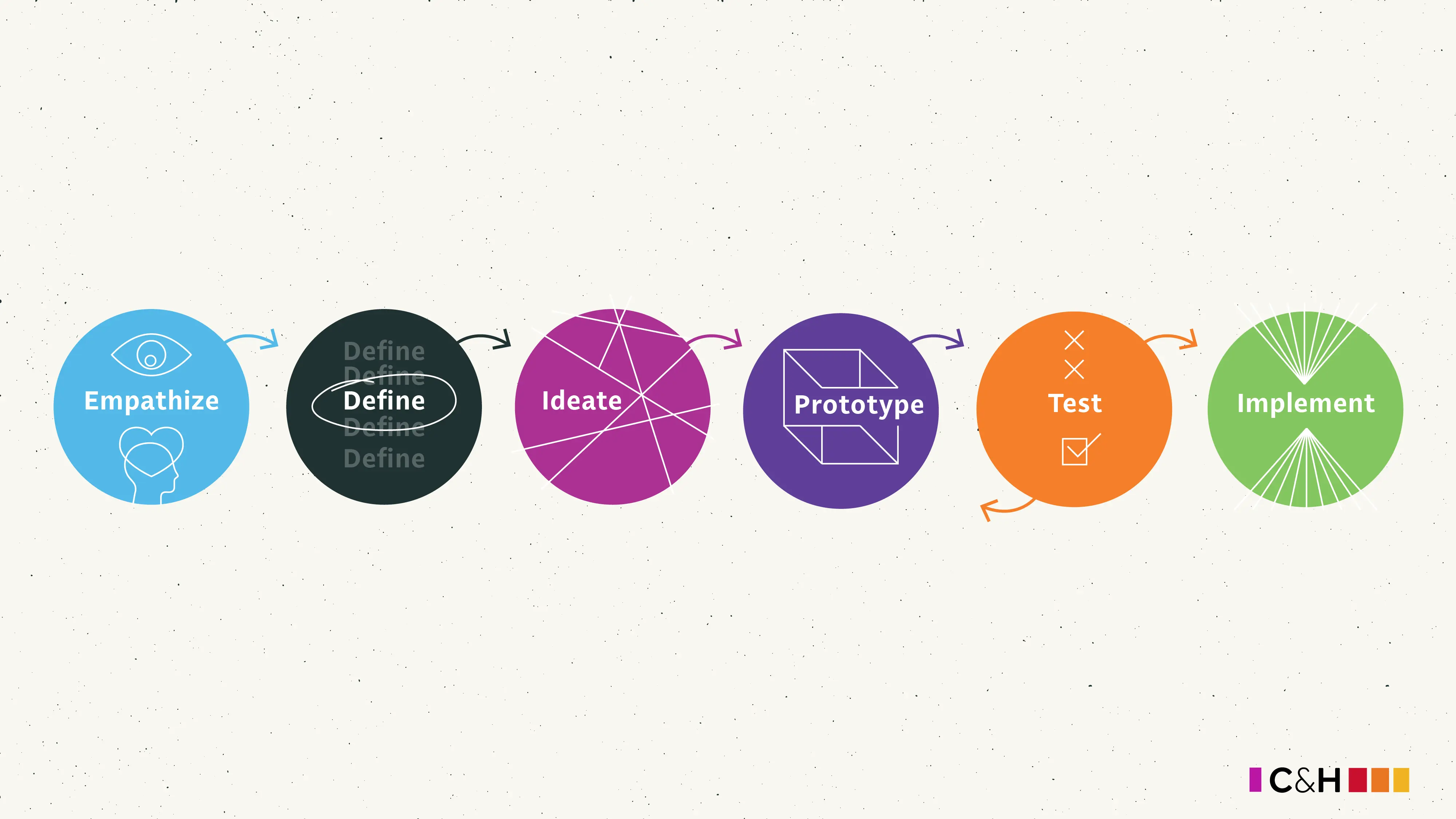
Design thinking is an iterative, empathy-led approach to designing products and experiences. It consists of 5 or 6 phases that include empathizing with the end user, defining the problem, ideating solutions, and creating and testing prototypes. Some design thinking firms, like Cast & Hue, add a sixth and final stage: guided implementation.
Rooted in collaboration, the approach brings diverse groups together and surfaces deep, qualitative insights to uncover solutions that work for end users (customers, employees, and patients).
Want a richer understanding? Read Cast & Hue’s guide to design thinking.
Core differences between agile, lean, and design thinking
While each approach is iterative and user-informed by nature, they have fundamental differences that offer unique benefits.
1. Strengths of each framework
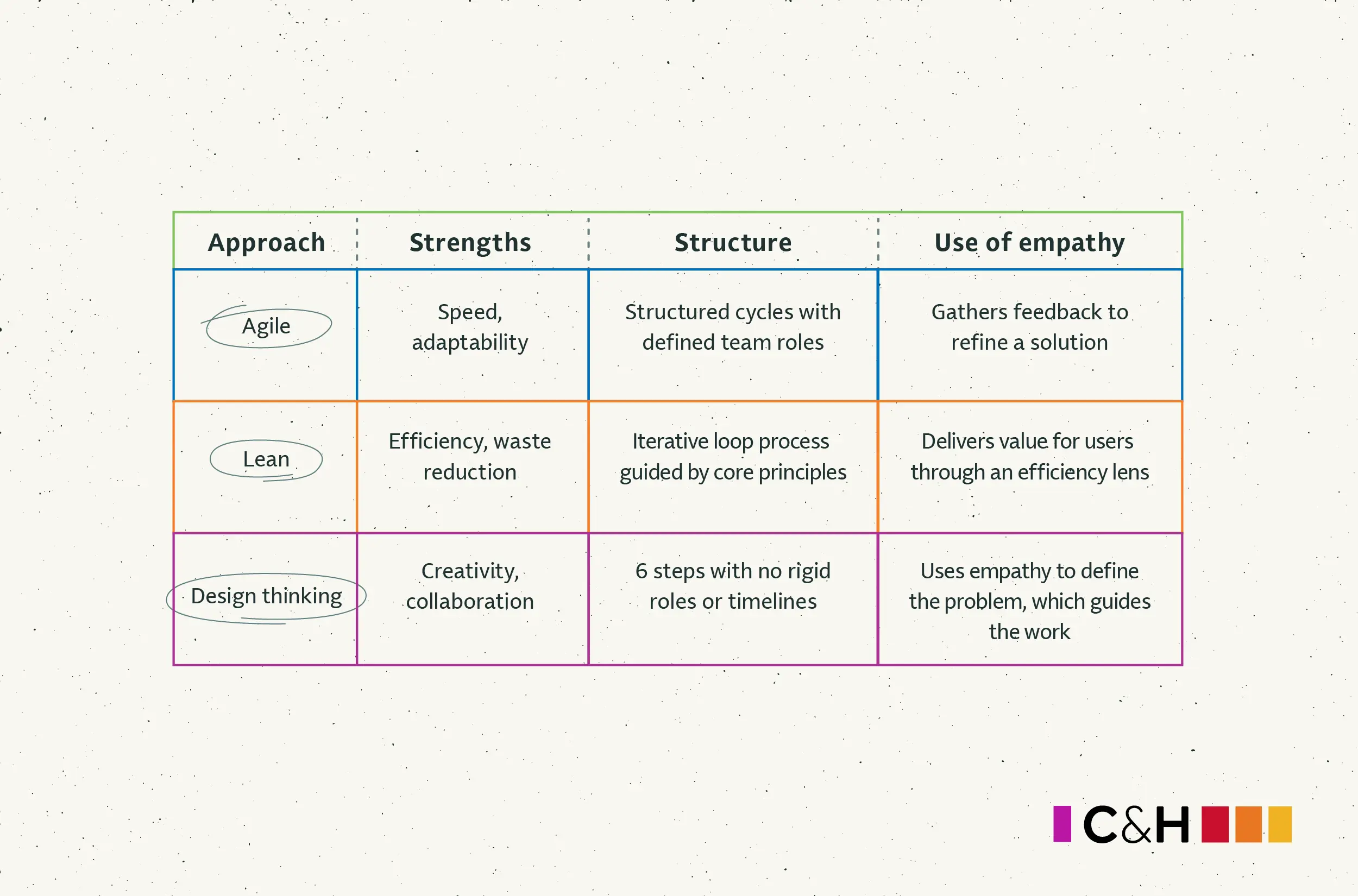
Agile is built for speed and adaptability. Teams using agile work in short cycles, gather feedback often, and refine as they go. Agile is helpful when you need to ship a solution quickly — for example, if you’re racing competitors to the market.
Lean improves efficiency. It excels at reducing waste, streamlining processes, and making workflows more consistent. When you already know where the pain points lie, you might use lean to tighten operations and help things run more smoothly.
Design thinking is best for abstract or complex situations. When the challenge is multidimensional and involves human emotion (as with experience design projects), design thinking helps teams accurately identify the problem(s) and co-create solutions that work for end users.
Framing the problem from the end user’s perspective is key to design thinking. While lean and agile focus on building the thing right, design thinking ensures you are building the right thing.
Agile vs. lean vs. design thinking: Key questions
You can distinguish the models by looking at the core question each one tries to answer:
- Agile: “How can we make progress quickly and iteratively?”
- Lean: “How can we make this process more effective?”
- Design thinking: “How can we think outside the box to solve this complex challenge?”
2. Level of structure
Agile, lean, and design thinking are also structured in unique ways.
Agile is the most prescriptive. Teams move through defined development cycles (sprints) and operate with clearly outlined roles, such as product owner or scrum master.
Lean follows core principles and the Build-Measure-Learn loop, where teams continuously refine a process by testing changes and deciding what to eliminate. Certain methodologies like Lean Six Sigma require training to participate in effectively.
Design thinking follows 5-6 steps, but the process is flexible. There are no rigid roles or timelines, and participants can learn the model as they go with guidance from a facilitator. The process is collaborative, creating a flat hierarchy where everyone can contribute ideas equally.
3. Level of empathy
The tug-of-war between empathy and efficiency is where the 3 approaches most clearly differ.
Design thinking puts empathy at the core by starting with an understanding of human needs. Teams immerse themselves in what customers, patients, or employees are actually experiencing to design human-centered solutions that resonate on a deeper level.
Agile and lean are still user-informed, but they focus on efficiency. Agile helps teams move quickly; lean helps them reduce waste. Both models approach projects through a performance lens rather than an emotional one.
Comparing design thinking vs. agile vs. lean
Best design approach for customer experience problems
Should you use design thinking, lean, or agile to solve an experience problem? When emotion is involved, design thinking has the advantage.
Experience problems are rarely just matters of efficiency. They stem from unmet emotional needs. Design thinking surfaces those needs and defines the right problems from the end user’s perspective, so that business-centric thinking doesn’t hijack the process. Without this focus on empathy, lean and agile risk creating experiences that are efficient but not effective.
(Design thinking is a great fit for more than experience design initiatives. Explore additional use cases for design thinking.)
.webp)

.png)


.png)